Money
RedotPay in Tunisia
Card Fees, P2P Top-Up, Safe Wallet Transfers and the Legal Position
This post contains promo codes and partner links, marked as such. If you sign up through one, I may receive a reward from the provider, at no extra cost to you. This does not change the order of the options or what I say about their risks.
In short On this page
RedotPay works technically in Tunisia as of October 2026: the Hong Kong crypto Visa card does not exclude Tunisian citizens and can be topped up through RedotPay's own P2P Marketplace or Binance P2P. No Tunisian text authorises residents to buy or hold crypto, so residents of Tunisia who fund a RedotPay card are legally exposed under the exchange code (law 76-18).
- 1. What is RedotPay and how does the card work?
- 2. How do you top up RedotPay with P2P?
- 3. How does RedotPay compare with the technology card?
- 4. How do you send USDT or USDC without losing them?
- 5. Glossary of crypto terms
- 6. Is a crypto card legal for residents of Tunisia?
- Frequently asked questions
- Official sources
What is RedotPay, how do you top it up, and can you use it from Tunisia?
RedotPay is a Hong Kong fintech that lets you spend stablecoins such as USDT and USDC with a Visa card, online, in shops and at ATMs. Its official pages do not exclude Tunisian citizens or users located in Tunisia (checked 10 October 2026). Below you will find what the card costs, how to top it up through P2P, how it compares with the Tunisian technology card and how to send stablecoins safely. The legal position for residents of Tunisia is in the last section.
RedotPay is only one of the four routes compared in how to pay Italian university fees from Tunisia, next to bank transfer, the technology card and PayPal on pagoPA.
1. What is RedotPay and how does the card work?
RedotPay (opens in a new tab) is a crypto card service that describes itself as "a fintech service provider and not a bank" (RedotPay): you deposit crypto, mainly stablecoins such as USDT or USDC, and spend it with a Visa card (the network named in its Terms). The physical card also works at ATMs.
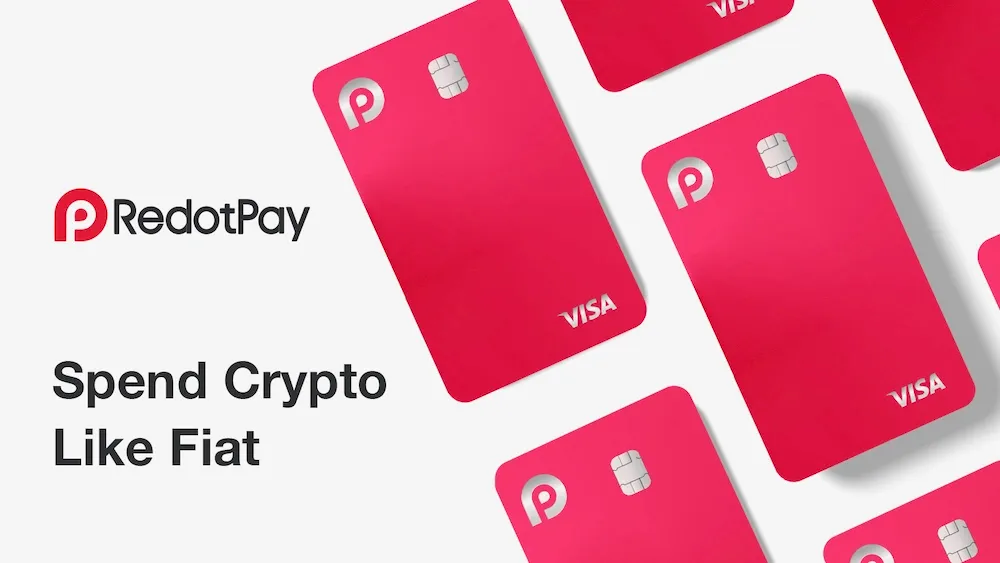
RedotPay card fees (as of October 2026)
There is no monthly or annual maintenance fee. Funding with a bank card costs 3% (minimum 1 USD).
| RedotPay virtual cardSource (opens in a new tab), checked Oct 10, 2026 | 10 USD |
|---|---|
| RedotPay physical cardSource (opens in a new tab), checked Oct 10, 2026 | 100 USD |
| RedotPay foreign-currency feeSource (opens in a new tab), checked Oct 10, 2026 | 1.2 % |
| RedotPay crypto conversion feeSource (opens in a new tab), checked Oct 10, 2026 | 1 % |
Estimates as of October 2026; check the source before you pay.
- Limits: up to 100,000 USD per transaction; ATM withdrawals 3 a day and 30 a month, up to 3,750 USD a day on a USD card (lower in some countries) (fee and limit table).
- KYC: a photo of your original ID, a face scan, your home address and 4-5 questions on your job and source of funds (identity verification).
- Who holds the money: balances are held by Red Dot Trust Ltd, a Hong Kong trust company. The Terms say the account is not a bank account.
- Binance Pay: Binance ended Binance Pay support on RedotPay on 3 April 2026 (Cointelegraph (opens in a new tab)), so a Binance top-up now goes through a normal crypto withdrawal to a RedotPay deposit address (see the P2P top-up section below).
2. How do you top up RedotPay with P2P?
You can top up a RedotPay (opens in a new tab) balance with P2P in two ways: buy USDT or USDC from another user in RedotPay's own P2P Marketplace, or buy on Binance P2P and withdraw the coins to your RedotPay deposit address. P2P (peer-to-peer) means buying crypto directly from another person on a platform: you pay them in local money, and the platform holds their crypto in escrow until they confirm your payment.
Route 1: RedotPay's own P2P Marketplace
Inside the RedotPay app, the P2P Marketplace lets you buy USDT or USDC from another user, and the crypto lands directly in your RedotPay balance, with no transfer between apps. The seller's crypto is held in escrow during the order. RedotPay states that its P2P "does not guarantee the settlement" of trades, so the same precautions as on any P2P platform apply.
Route 2: Binance P2P, then a deposit to RedotPay
Buy USDT or USDC on Binance P2P, then withdraw it from Binance to your RedotPay deposit address. In RedotPay, open the deposit page and pick the coin and network first; in Binance, choose exactly the same coin and the same network (for example USDT on Tron (TRC20) to a USDT TRC20 address). The network charges a withdrawal fee, and a mismatch can mean lost funds: follow the stablecoin safety steps below and send a small test first.
How an escrow order works, step by step
- Choose an adIn the P2P zone you pick a seller; in Express the system picks one. Read the seller's terms and check their completion rate.
- The crypto is lockedWhen you place the order, the seller's crypto is reserved in escrow.
- Pay outside the appPay with the method shown in the order, from an account in your own name, within the payment window (often 15 to 45 minutes).
- Notify, then waitTap "Transferred, notify seller" only after paying. The seller checks and releases the crypto. Never cancel after paying; use the Appeal button instead (Binance guide (opens in a new tab)).
Fees and the name rule
On Binance's P2P fee page (opens in a new tab) (checked 10 October 2026), a taker in the P2P zone paid 0%, a maker 0.20%, and Express cost the taker 0.10%. The real cost is the gap between buy and sell prices, plus bank fees and the network fee of the withdrawal. On both platforms, the payer's name must match the counterparty's verified name: a payment from someone else's account can be refused or frozen.
Signing up for RedotPay through the partner link below gives you its 5 USD welcome reward, and the promo code is applied automatically.
Typical P2P scams
| Scam | How to spot it |
|---|---|
| Fake proof of payment | Check your own bank app, never a screenshot. |
| Fake SMS | Log in to your account; texts can be forged. |
| Third-party payment | The payer's name differs from the verified name. |
| Man in the middle | The deal starts on Telegram or WhatsApp. |
| Fake support | Binance never emails you to finish a P2P order. |
3. How does RedotPay compare with the technology card?
RedotPay offers higher limits and is funded with crypto, while the Tunisian technology card (CTI) is the card the BCT authorises for residents of Tunisia, within a yearly allowance in dinars.
| RedotPay | Technology card (CTI) | |
|---|---|---|
| Who can open it | Tunisian citizens are not excluded; approval not guaranteed | Tunisian residents with at least the baccalaureate |
| Card network | Visa | Not stated on issuer pages |
| Card fee | 10 USD virtual, 100 USD physical, no monthly fee | Varies by issuer (Banque Zitouna: 20 TND a year) |
| FX / conversion cost | 1.2% FX + 1% conversion | Your bank's rate and fees |
| Limits | 100,000 USD per transaction | 1,000 TND per calendar year |
| How it is funded | Crypto deposit, bank card (3%), P2P | Dinars at a Tunisian bank or La Poste |
| Legal status for residents of Tunisia | No authorising text; exposed under the exchange code (section 6) | Legal, for the uses listed by the BCT |
| Main risks | Freezes, no deposit insurance, lawsuit | Narrow list of allowed uses |
For residents of Tunisia, the card the BCT allows is the international technology card, within the uses it permits.
4. How do you send USDT or USDC without losing them?
To send USDT or USDC safely, use the same coin and network on both sides, copy the address with the app's button, check it and send a small test first, because crypto transfers cannot be reversed. In the EU, Binance notes MiCA restrictions on unauthorised stablecoins, so USDC may be easier than USDT.
Step 1: same coin and same network on both sides
Choose the coin and network in the receiving app first, then exactly the same pair in the sending app (RedotPay withdrawals).
Step 2: copy the address with the copy button or QR code
Use the app's copy button or scan its QR code. Never type an address by hand.
Step 3: compare the first and last characters
Compare the first 6 and last 6 characters with the original, plus a few in the middle.
Step 4: never copy an address from your history
In address poisoning, scammers send a tiny transfer from a lookalike address so it shows in your history. Copy only from the receiving app or your address book.
Step 5: send a small test first
Send a small amount above the minimum, wait for it, then send the rest to the same saved address.
Step 6: check the TxID on a block explorer
Paste the TxID into the network's explorer (Solscan, BscScan, PolygonScan) to see the amount, receiver and status (Binance Academy (opens in a new tab)).
Step 7: whitelist your addresses
Turn on the withdrawal whitelist (opens in a new tab) and save each address with a clear label, coin and network.
Step 8: never share your seed phrase or 2FA codes
Real support staff never ask for your seed phrase, passwords or 2FA codes.
5. Glossary of crypto terms
Key facts
- Wallet
- An app or account that holds your crypto and lets you send and receive it.
- Address
- A long string of letters and numbers, like an IBAN for crypto.
- Network / chain
- The road the money travels on (Solana, BNB Smart Chain, Tron…). Both sides must use the same one.
- Stablecoin
- A token designed to stay worth 1 US dollar.
- USDT
- The most common dollar stablecoin, issued by Tether.
- USDC
- A dollar stablecoin issued by Circle.
- Gas fee
- The fee paid to process a transfer on a network.
- P2P
- Buying crypto directly from another person on a platform.
- Escrow
- The platform locks the seller's crypto until the deal is complete.
- KYC
- Identity verification (ID and face scan) before you can use the service.
- Test transaction
- A small send to check the address before the main transfer.
- Block explorer
- A public website where anyone can look up a transfer.
- TxID
- The unique reference of a transfer, like a bank transfer reference.
6. Is a crypto card legal for residents of Tunisia?
No Tunisian text makes funding a crypto card legal for residents of Tunisia: no Tunisian law or Central Bank (BCT) circular that expressly authorises buying crypto or stablecoins could be found. The exchange code (law 76-18 (opens in a new tab)) sets the frame:
- Art. 3: foreign-exchange operations go only through the BCT or authorised intermediaries (banks, La Poste).
- Art. 16 and 17: residents must declare their assets abroad and may not dispose of them without authorisation. A crypto balance on a foreign platform is arguably such an asset.
- Art. 21: settlements between residents take place in Tunisia and in dinars.
- Art. 35: offences are punishable by 1 month to 5 years in prison and a fine of at least five times the amount involved.
Buying USDT with dinars, through P2P or a foreign card, sits outside these channels, so residents of Tunisia who fund a crypto card are legally exposed under the exchange code. Binance's Terms (opens in a new tab) also exclude users for whom using it would be illegal locally, even if their country is not on its prohibited list (opens in a new tab). A new exchange code (bill 115/2025) is under discussion but had not been adopted at the last report found. Read more in the exchange rules section of our payment guide.
Frequently asked questions
Does RedotPay work in Tunisia?
Yes, technically: as of October 2026, Tunisia is not on RedotPay's unsupported-nationality or blocked-location lists, so Tunisian citizens can apply, although approval is not guaranteed. Legally, no Tunisian law or BCT circular authorises residents to fund a crypto card, so residents of Tunisia who use RedotPay are exposed under the Tunisian exchange code (law 76-18).
Is there a RedotPay promo code?
Yes: the promo code j2eb5 gives a 5 USD welcome reward on a new RedotPay account, as RedotPay's sign-up page shows in October 2026. Enter the code when you register, because it cannot be added later. The reward must be used within 30 days and cannot pay the card fee, and fees, limits and plans are the same as a normal sign-up.
How much does the RedotPay card cost?
The RedotPay virtual card costs 10 USD and the physical card 100 USD, with no monthly or annual fee. Payments in another currency add 1.2%, and converting crypto to spend it adds 1%. RedotPay publishes the current fees and limits in the fee and limit table of its help centre, and they change over time, so check it before you order a card.
How do I top up RedotPay with USDT from Binance?
Buy USDT on Binance P2P, then withdraw it from Binance to your RedotPay deposit address using exactly the same coin and network on both sides, for example USDT on Tron (TRC20). Send a small test transfer first and wait for it to arrive. Binance no longer supports Binance Pay on RedotPay, and RedotPay's own P2P Marketplace lets you buy USDT directly inside the app instead.
What is Binance P2P and is it safe?
Binance P2P is a marketplace where you buy crypto from another user while Binance holds the seller's crypto in escrow until the order is complete. Escrow reduces the risk, but it does not stop fake payment proofs, forged SMS, third-party payments or deals moved to Telegram or WhatsApp. Pay only from an account in your own name, and never cancel an order after paying: use the Appeal button instead.
What happens if I send USDT on the wrong network?
The funds are usually lost. Binance's Terms say crypto sent to an incompatible address is lost, and any recovery attempt is paid and not guaranteed. To avoid it, choose the coin and network in the receiving app first, pick exactly the same pair in the sending app, and send a small test transfer before the main amount.
Can RedotPay freeze my account?
Yes. RedotPay's Terms allow it to freeze or close an account at any time, without notice, and no deposit insurance is mentioned. Users on Trustpilot report funds blocked for weeks during source-of-funds checks, so do not rely on a RedotPay balance alone for a payment with a deadline.
Official sources
- RedotPay: card limitations and fees (opens in a new tab)
- RedotPay: identity verification requirements (opens in a new tab)
- RedotPay: unsupported countries and regions (opens in a new tab)
- RedotPay: location-based access restrictions (opens in a new tab)
- RedotPay: Terms of Service (opens in a new tab)
- RedotPay: P2P Marketplace (opens in a new tab)
- RedotPay: withdrawing crypto to another wallet (opens in a new tab)
- Binance: Terms of Use (opens in a new tab)
- Binance: list of prohibited countries (opens in a new tab)
- Binance: buying crypto via P2P (opens in a new tab)
- Binance: how to avoid common P2P scams (opens in a new tab)
- Binance: P2P fee rates (opens in a new tab)
- Tunisian Ministry of Finance: exchange code (law 76-18) (opens in a new tab)
- Banque Centrale de Tunisie: circular 2016-09 (technology card) (opens in a new tab)